Two things are happening on stage tonight: a very old percussion tradition is being played, and a very old ceremony is marking Ani's readiness to play it in public. Here's what each one means.
The Mridangam
The mridangam is the principal percussion instrument of Carnatic (South Indian classical) music — both rhythmic anchor and active musical voice. Its name is commonly traced to the Sanskrit mrid (clay or earth) and angam (body), recalling the clay shells used by early forms of the instrument. Across centuries, it moved through temples, devotional gatherings, dance, storytelling, and royal courts before becoming central to the modern concert stage.
Two hands, two skins, one instrument — and neither hand plays the same thing.
The modern mridangam is carved from a single hollowed block of jackfruit wood (panasa), roughly 22 to 24 inches long, with walls about an inch thick. Two drumheads — each made of layered goat and buffalo skin — are laced to opposite ends of that wooden body with leather straps pulled to very high tension. The two heads are deliberately unequal, and that asymmetry is the whole instrument:
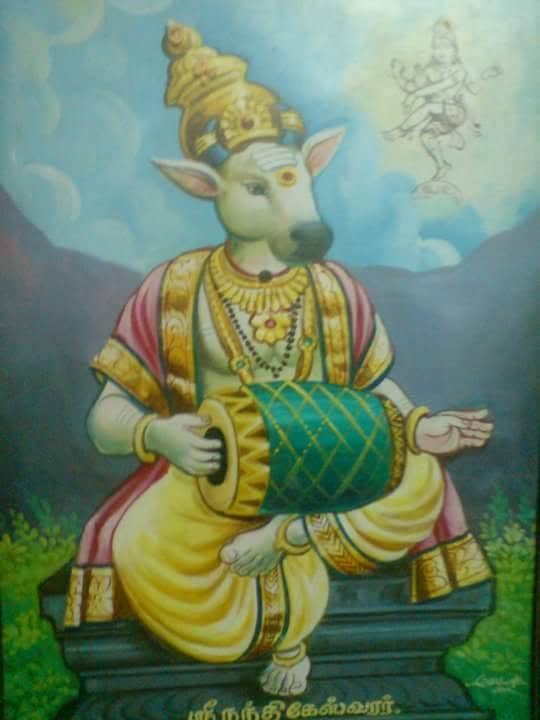
"Lord Nandikeshwara" is considered a God of Mridangam. According to Indian mythology, Lord Nandi (the bull), escort of Lord Eshwara, accompanied the mridangam for the Rudra Thandava — the divine performance of Lord Rudra.
- Valanthalai — the smaller, treble head, played with the right hand.
- Syahi — the black paste circle at the center of the valanthalai, tuned by hand to give the head its clear, pitched tone.
- Thoppi — the larger, bass head, played with the left hand.
- Lacing & tension rings — leather straps under high tension connect the two heads along the body. Striking a ring toward the body raises the pitch; striking away from it lowers the pitch.
Tuning happens by ear, with a stone, moments before playing — which is part of why you'll sometimes hear a few sharp taps around the rings before a concert begins. It isn't a malfunction; it's the instrument being brought into tune with the singer's pitch for the evening.
From sacred spaces to the concert stage
Rhythm in South Indian tradition has long organized worship, movement, oral storytelling, and communal memory. As Carnatic music developed, the mridangam's role expanded beyond keeping time: the player supports vocal phrasing, answers improvisation, shapes tension and release, and helps the ensemble return precisely to the rhythmic cycle.
The shift from clay to durable wooden shells — most often jackfruit wood — gave the instrument greater projection, tuning stability, and resilience in larger venues. Yet its teaching remains deeply personal and oral: students learn both strokes and spoken rhythmic syllables, building the timing, hand independence, memory, and listening awareness that take years to mature.
The Arangetram
Arangetram comes from the Tamil arangam (stage) and etram (ascending) — literally, "ascending the stage." It's the ceremony in which a guru formally presents a student to the public for the first time, after years of training that, until this point, has mostly happened in private: in a teacher's front room, in rented studio time, in the after-school hours nobody else sees.
The ceremony's roots go back to South Indian temple life and the devadasi tradition, where a dancer or musician's training culminated in a performance dedicated to the presiding deity, inside the temple itself. The modern arangetram moved that occasion from the temple to the concert hall, but kept its shape: a teacher stepping back, in public, to let a student step forward.
Not a graduation — a beginning. The point at which a student is ready to offer the art on their own.
That's worth sitting with for a second, because it cuts against how Western audiences usually read a recital. Tonight isn't the end of Ani's training, and nobody in the room — including Ani — would call it a finished performance in the sense of "as good as it gets." It's the first time the training is offered outward instead of inward: the first time it's for an audience instead of a teacher.
Ani's story
A little Carnatic music, for tonight
Carnatic music is built on two things: ragam — a melodic scale, each with its own character and, traditionally, its own time of day — and thalam — a rhythmic cycle that repeats underneath the melody. You'll see both listed for every piece in tonight's printed program, along with a plain-English note on what to listen for.
A few thalams you'll hear referenced tonight: Adi (8 beats — the cycle behind the small ring motif used throughout this site), Rupakam (3 beats), Misra Chapu (7 beats), and Khanda Chapu (5 beats). A concert conventionally opens with an invocation to Ganesha, the remover of obstacles, and closes with the benediction Pavamana. Somewhere in the middle, the mridangam gets its own moment — the thani avarthanam, a featured solo where the melody drops out and the rhythm speaks for itself. Watch for it; it's marked clearly in tonight's program.
- Ragam Melodic scale — gives a piece its color and, traditionally, its time of day.
- Thalam Rhythmic cycle — the count everything else sits inside.
- Thani Avarthanam The percussion solo — tonight, Ani's.
- Ragam Tanam Pallavi The most technically demanding item in a Carnatic concert, largely improvised across three movements.